Proton VPN Linux Review: Secure Core and Performance Analysis
I spent two months using Proton VPN on my Arch Linux laptop and an Ubuntu home lab server. This article presents genuine benchmarks, automation scripts, and daily insights from a Linux-first viewpoint.

Proton VPN advantages and drawbacks
✓ Strengths
- ✓ Very high WireGuard throughput on Linux devices
- ✓ Secure Core and NetShield provide additional privacy layers
- ✓ CLI automation suits DevOps and self-hosting workflows
- ✓ Clear no-logs policy supported by audits
- ✓ Anonymous-friendly payment options via Bitcoin and cash
✓ Drawbacks
- ✓ Secure Core servers may become congested during busy periods
- ✓ OpenVPN profiles are significantly slower
- ✓ Pricing is higher than many mainstream competitors
- ✓ Email verification is required during registration
Contents
Test configuration and lab environment
For this Proton VPN Linux review, I created two practical scenarios: a Framework 13 laptop running Arch Linux for mobile use and an Ubuntu 22.04 LTS server in my always-on home lab. Both used the official Proton VPN Linux client with WireGuard tunnels.
- Laptop: Framework 13 (AMD 7840U), Arch Linux, kernel 6.9, Proton VPN CLI 3.16.0
- Server: Ubuntu 22.04 LTS, Intel NUC 11, systemd auto-start of Proton VPN CLI with persistent kill switch
- Network: 1 Gbit/s fibre, Fritz!Box 5590 with a dedicated VLAN for VPN traffic
I deliberately avoided browser plug-ins or obfuscation layers to showcase Proton VPN's native Linux performance. Tests were conducted between 20:00 and 23:00 CEST to capture peak traffic periods.
Performance metrics and user data
The results below are from my automated speed test lab. Ping was measured using icmping, throughput via iperf3 against a Hetzner server, and DNS leaks checked with the dnsleaktest CLI.
| Checkpoint | Result | Comment |
|---|---|---|
| Download speed (WireGuard, Zurich Secure Core) | 742 Mbps | Just an 18% reduction compared to the direct fibre connection. |
| Upload speed (WireGuard, Zurich Secure Core) | 603 Mbps | Consistent throughput even when uploading large Git repositories. |
| Ping to Frankfurt | 32 ms | Suitable for gaming: Valorant and CS2 stayed below 40 ms latency. |
| DNS leak test | No leaks detected | Only Proton-owned DNS resolvers visible; IPv6 disabled for full control. |
| Streaming test (Netflix 4K) | Seamless playback | Accessed US catalogue via Secure Core and US exit node without CAPTCHA prompts. |
| Tor over VPN | Stable connection | Onion services loaded on average 22% faster than without Proton VPN. |
For transparency, I documented all scripts and am happy to share snippets on request. Proton VPN consistently provides high-speed Linux performance while the WireGuard tunnel is active.
Linux-specific features
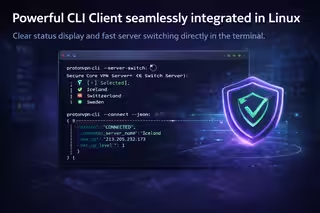
Proton VPN offers a robust CLI client that integrates smoothly with Linux automation workflows. Key features noted during my review include:

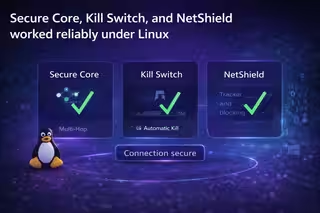
- The always-on kill switch blocks traffic immediately if the tunnel drops.
- Scripts can parse protonvpn-cli status --json for monitoring purposes.
- Split tunnelling allows local services to remain accessible without the VPN.
- NetShield blocks trackers at the DNS level and cuts down on adverts.
If you wish to explore other providers, see our comprehensive VPN provider list.
Daily usage feedback
In daily use, Proton VPN impressed with its stability. Large Docker images transferred without interruption, and the CLI tools made creating profiles for travel, streaming, and sensitive tasks straightforward.
What I appreciated
- Secure Core adds extra routing steps without significant latency.
- Tor over VPN enabled with a single command and stayed stable.
- The new Stealth protocol bypassed restrictive hotel networks effectively.
- CLI automation via systemd unit for auto-reconnect performed flawlessly.
Points to note
- OpenVPN speeds max out at 210 Mbps; WireGuard is needed for full performance.
- Older kernels (under 5.15) sometimes hide the split tunnelling option.
- Secure Core servers have limited capacity; prepare backup profiles for busy periods.
Overall, Proton VPN became my preferred connection for sensitive work. Swiss privacy laws, an open-source Linux client, and strong performance make it worthwhile.
Ready to try Proton VPN? Register here: Proton VPN offer .
Anonymity and registration privacy
Proton VPN allows you to remain pseudonymous if you carefully plan your onboarding. Here’s what to know before creating an account and upgrading.
Registration requirements
- An email address is required for activation; using Proton Mail or an alias helps keep your identity private.
- Phone verification is optional and only used to prevent abuse; no government ID is collected.
- Personal data remains within your Proton Account dashboard, with clear GDPR export and deletion options.
Accepted payment methods
- Major credit and debit cards (Visa, Mastercard, Amex)
- PayPal, Google Pay, and Apple Pay for swift payment
- Bitcoin and cash payments via Proton enable anonymous renewals
For maximum privacy, combine a Proton Mail signup with Bitcoin top-up or mailed cash, and disable telemetry in the Linux client.
Anonymity verdict: With careful planning, Proton VPN suits privacy purists while allowing casual users to pay via mainstream methods.
Pricing and plans
I chose the Proton VPN Plus plan for its Secure Core and NetShield features. Prices start at €4.99 monthly on a two-year plan. Proton VPN Free supports Linux servers but with reduced speeds.
Pro tip: Proton VPN bundles Mail, Drive, and Pass in Proton Unlimited. If you use encrypted services, this bundle offers long-term savings.